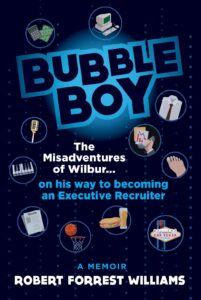
Our latest book is entitled, Bubble Boy: The Misadventures of Wilbur on his way to becoming an Executive Recruiter. Wilbur is the pseudonym of author Robert (Bob) Forrest Williams. The former stand up comedian has a hilarious tale to tell. We caught up with him recently to chat with him about it, and give you a taste of what you can expect if you read this book. (Available for pre-order now!)
EP: So, let’s address the first question everyone has about this book. Is it about that kid John Travolta played in the 1970s TV movie? If not, why Bubble Boy?
Bob: I get that question a lot. And even if someone doesn’t ask it directly, I know they are thinking that. I feel compelled to explain. Of course, my book has nothing to do with the Travolta movie. In fact, while I have some knowledge of those real-life circumstances, I have never seen the actual movie. I Googled “The Boy in the Plastic Bubble” and found that it came out in 1976. I was a freshman in college at that time and didn’t have a television in my small dorm room to watch it even if I wanted to. I am more aware of the famous Seinfeld episode where the character of George Castanza gets in an argument with the “Boy in the Bubble” while playing Trivial Pursuit – resulting in a physical struggle between two – and the tragic result of that. Dark, but Hilarious!
Getting that out of the way, I suppose I didn’t even need the title of my book to be “Bubble Boy.” It could easily have just been the subtitle, “The Misadventures of Wilbur on his way to becoming an Executive Recruiter.” But the timeframe that the Recruiting section of the book took place – 1996 to 2000 – coincided exactly with the famous IT/.dotcom bubble and it’s subsequent bursting – setting the economy into a tailspin. In fact, I was not even remotely aware of the concept of “bubble” – economically, philosophically, or otherwise – until it was identified as such at the time. We hear it all the time now. Someone on the news wondering if we are currently in an AI (Artificial Intelligence) bubble.
When I thought about that first recruiting job, I realized I was certainly in a bubble. It was a defined moment in time for me and the world. Thank God, that it wouldn’t happen again. Oh wait! It DID happen again. And again, and again. September 11th, the Economic Recession from the Mortgage Meltdown, Covid… I found myself the victim of each subsequent event. I was truly a “bubble boy” just riding the economic times as they came and went. When I thought about it in those terms, I couldn’t get that book title out of my head. I knew the risks of the association with the previous TV movie – but also knew that copyright laws protected book and song titles. So, I went with it and used the bubble metaphor throughout the rest of the book. I like that the question gets begged though. The whole topic could just as well be dismissed if it wasn’t so obvious.
EP: There are so many funny anecdotes in the book. You have a gift for telling a story. If you had to pick out an anecdote that you like telling the most, what would it be?
Bob: Thank you for your flattery on my story-telling ability. My life is as different as anyone else’ but I do seem to remember events in humorous ways. When you and I first met you asked, “Why do you think you could write a book?” My response was that I believe that I have had many UNIQUE experiences. Like when my mother substituted salt in the sugar bowl and watched straight-faced as I loaded up the “sugar” in my breakfast cereal – and then howled in laughter when I spat it out in anguish a minute later. How many people have had that happen to them?
I think the description of the demolition derby during my fraternity days in college is the anecdote I like telling the most. Mainly because I think it plays like scenes right out the movie “Animal House.” As I mentioned in the book, that movie had come out shortly after I joined the frat. Bad timing for my university as it validated and exacerbated our chosen lifestyle – “Anything Goes.” And EVERYTHING went. The Demolition Derby was no exception.
Our frat house backed up to an empty lot we called “The Back Forty.” Every spring the house would purchase several cheap, beat-up – but still running cars to be in the derby. Glass windows were broken out, and cars were painted with vulgar terms to make them safe and amusing to all onlookers. It was an EVENT and many students from the university came out to watch.
The day before the derby two noteworthy events took place. A cousin of mine and her mother had come to visit campus to see if that would be a good place for her to go to college. They implored me to take them to my fraternity house. My firm response: “No.” Frankly, they would not have been prepared to see what I saw there daily. Decadence to the nth degree. “Well then, can we just drive by?” “OK.” As we drove by, we all witnessed one of my “brothers” kneeling on the front of a car in the front yard, smashing the front windshield with a cinder block. He kept smashing and smashing with chards of glass going every which way. How he escaped without being injured is beyond me. As we witnessed this my aunt inquired, “Bob, what is that young man doing?” I didn’t have an answer that made sense. I mumbled something like, “Uh, have you seen the Union yet? Let’s go there….” And we moved on. My cousin ended up going to college elsewhere.
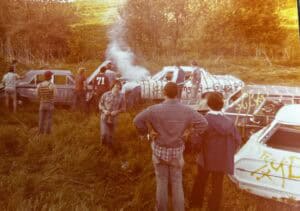
Meanwhile one of the brothers parked his real car in town five miles away and left it there overnight to be sure that he didn’t put it in the derby the next day. Well, you can guess the rest. The next day to everyone’s entertainment -cars were crashing into each other with reckless abandon, and “Biff’s” absence was noted. Where was he? Right around that time, screeching tires were heard coming around the corner, and his car (We dubbed “The White Ghost”) was making its way onto the Back 40. Cheers were heard as he smashed into any cars remaining. With one car left he put it into reverse and backed into it with a considerable amount speed. In an instant, cheers went to fears as a mushroom cloud of flames exploded out of the Ghost’s trunk. It careened across the field and left a wall of flames in its wake. Driver and riders exited immediately, and no one was hurt. Cheers rose again! The fire department was on the scene shortly thereafter and we brothers sang our frat theme song while the flames were being doused. As I mentioned in the book, it’s my favorite college memory. It would have made a great scene in Animal House – but it was Real Life which made it better!
EP: The main part of this book is about your time as an Executive Recruiter. That wouldn’t seem like an industry packed with lots of stories, but oh boy, is that wrong. Take a walk on the shady side of life and show us a thing or two you had no idea you’d encounter.
Bob: Well first, I think I need to put my first recruiting job in context. When I joined that firm I was just about to turn 40 years old, and up until then my career had been fairly conventional. That is, I worked for large corporations which were legitimate businesses. I was like any other hired employee – showing up every day, doing my best, and trying to get noticed and promoted to a better paying status. This did happen on occasion, but sparingly. Noteworthy among these firms was what I referred to in the book as “The Bank.” To this day a prominent financial institution in the heart of the Loop. Handling other people’s money is serious business. To be seen engaging in any unethical practices would have had them going out of business immediately if discovered. I had also completed a graduate program at Loyola University of Chicago. As a Jesuit institution they value and teach “Ethics” as part of their curriculum. You will not exit that institution without knowing “right from wrong.” Nevertheless, one day I decided I had had enough of bank life and resigned. It took me nine months to get back on my feet again in that first small IT recruiting firm which I describe as “The Wild West” or “Rock & Roll.” My career was upended – similar I think, to when the Beatles first arrived in America. Nothing was the same from that time forward.
At once everything was different. Small vs. large. Not being paid a salary – working on commission. No dress code. No mandated work hours, though 9-5 was usual. No boss. No real rules. The thing that struck me was the IRREVERNCE of it all. My mentor Jobo summed it up by saying “We answer to no one. The suits work for us. They send us money for doing the things they won’t.” It was just what the doctor ordered for someone who had been ordered to “jump” his whole life, and now didn’t need to ask, “how high?” I embraced the new context, learned that business and did well. The bills started getting paid again. However, some of the ways in which we earned our fees were not quite “on the up and up.” But Loyola was in the rear-view mirror, and I did what I had to do to make a living.
I don’t want to paint the Staffing/Recruiting industry with a broad-brush. I can’t say that any of the dubious techniques we used were also used by other firms. This was fairly unique to this one office, and some of the individuals working there. But when dealing with people’s motivations, emotions, and feelings towards work and money you learned to expect the unexpected and improvise to ensure a successful transaction. That means getting a company to hire a candidate you presented and receive a considerable fee for orchestrating it all. Every deal is unique dealing with unique individuals. So yes, it seems counter-intuitive, but LOTS of stories emanate from those types of circumstances.
“Shady” practices included bribing candidates to take jobs by paying them a signing bonus out of our placement fee – the hiring firm ignorant of this fact. For all they knew the candidates were more than happy with their offers. “Takeaway” – a psychological technique for seemingly “ghosting” any opportunity the candidate might have to get an offer – was used often to keep them “in Control.” Control was the name of the game. The candidates were being manipulated to believe certain things – the way the Recruiter meant them to believe. Only then might they get the bona fide employment offer. 99% of the time the offer was extended via the Recruiter. For all the candidates knew everything said to them was legit. The truth was bent with only the fee to be made in mind. Outright lying was not uncommon. For this Loyola grad, it always didn’t feel right, but if everyone won (company hired good employee, employee got new job, firm got a fee, Recruiter got commission) it didn’t seem to be that harmful. The end seemed to justify the means.
Once the IT/dot.com bubble burst in 2000 almost everyone in that small firm left. The business model had dried up with the economy. I did get hired and employed by other firms over the next quarter century and the dubious practices described mostly became obsolete. What did not go away was the human element, which would require, now and then a little, shall we say, “creativity?”
EP: I don’t think anyone reading this book will be surprised that your career also included a stint as a standup comedian. That sounds like a glamorous life, but again, you showed us another side to it. Paint a picture of what life is like trying to make a living in comedy and give us the moment you consider your comedic pinnacle.
Bob: Here’s the picture I can paint for you about me trying to make a living as a standup comic. Poverty. I have often described it having the MOST fun in my life while making the LEAST amount of money. Seriously. You know that summary the Social Security Administration provides – showing your earnings for each year? For 2005 my earnings were $0. And I still ended up OWING the IRS money!
I started Standup in 1980 when the boom for that was just beginning. It was hard keeping up a schedule while working fulltime as well, so that didn’t last. When I made my “triumphant” return in 2003 I resolved that I wouldn’t’ have that obstacle in the way again. So, I quit working full-time. OK, I had a little help from my employer when they laid me off.
The cliché in standup is that most people drive ten minutes to an hour to get to their eight-hour job. In standup it’s the opposite. You sometimes drive 8 hours to the gig, only to do a 10 to 30 minute set. I wasn’t travelling nationally, but getting to locations was sometimes a hassle. When you are late and stuck waiting for the longest freight train in history to pass, it’s not a relaxing moment. That happened to me two days in a row. I think it was the SAME train coming around for the second lap! And forget about weather. Our friend Dobie Maxwell talks about this all the time. Treacherous storms can make the artform riskier than just trying to make people laugh with your silly jokes! I remember one rainstorm that was so bad that another comic and I were the only people who showed up. Potential audience members weren’t stupid, but we were, thinking “The Show Must Go On!” Many times, it really mustn’t. I had a gig in a bakery once. It was me and the booker. And nary a free donut was offered…
The biggest challenge was coming up with new material. I was constantly writing and trying out new stuff. Sometimes it worked and was left in. Sometimes it didn’t and was never heard again. Sometimes I’d try new things like playing a musical instrument to add to the comedic depth (LOL). In the book I talk about using my trumpet to some success in this regard. Another time I hauled a heavy electric piano onstage. The bits went over OK, but not at the expense of pulling muscles to get the darn thing up there in the first place!
I had a few performance “pinnacles.” Shows where I “killed” were like out-of-body experiences. Most comics know this feeling. It’s been compared to a heroin addiction, and you can’t get enough of it. Unfortunately, some of those performances were followed by “Bombing.” It’s a well-documented phenomenon. The more successful comics overcome this with years and years of honing their skills to a professional level that establishes their brand. You know what you are getting when you see Jim Gaffigan, Nate Bargatze, or Dave Chappelle. Wilbur? Let’s just say I wasn’t filling arenas!
I’d say the high point was my Standup career was on WGN TV’s Morning News Show. Getting a TV credit then was as huge as it is today. They ran a segment called “Chicago’s Funniest People,” and five comics performed. We each had one minute to make a panel of judges (including Radio DJ Steve Cochran and Saturday Night Live alumnus Tim Kazurinski) laugh.
The legendary magician Marshall Brodien was running around in his character “Wizzo the Wizard”, and comedian Mike Toomey played the MC in his Batman costume. Adding to the mayhem were Coach Mike Ditka and financial guru Suze Orman in separate show segments. It was all great fun!
I did well in one minute. Funny how my greatest life experiences have only taken just one minute! But I digress. Steve Cochran came up to me afterwards and told me he’d gladly provide an on-air plug for any of my subsequent performances. I was on an emotional high driving home from that experience. The next day I was just a normal person again, trying to pay his bills.
EP: Readers may be surprised by your introspection and deep thoughts. Your journey eventually leads you to Africa and a balloon ride over the Serengeti. What deep thoughts did you have at that moment?

Bob: Honestly, I don’t know if I had any “deep” thoughts. I did think about friends and family who were not there with me (I travelled alone with a tour group). But even if you are with other people, the impact of floating over the African savannah hits you personally. It was like seeing the Grand Canyon, Pacific Ocean, or some other major natural phenomenon for the first time. You’re just blown away by the majestic view and feel small by comparison.
Funny story though. I am extremely acrophobic (I can’t even get up on a ladder without getting the “willies) and slightly claustrophobic. So, what better activity in which to partake than a hot air balloon ride – Right?! When I was booking the trip to Africa, I told the representative that I was a bit concerned about one aspect of the trip, and could she guess what that was….? She said, “Oh I don’t know…. getting eaten by lions…?” I said, “No, it’s the balloon ride – but thanks for putting THAT into my head as well!”
In hindsight the balloon ride was awesome. Though I did have a couple “Holy Crap we are sooooo high!” moments. And there was cause for slight concern when our pilot realized he had miscalculated our landing point by about 5 miles – and had to make a drastic course change – missing a collision with a tree by mere feet. My “undeep” thought when it was over was “I survived!” The ceremonial champagne toast following the flight tasted that much sweeter.
One of my friends who read the unedited manuscript of the book told me that I just HAD to include something about the Africa trip. The balloon ride seemed like a natural since it and the sunrise could both be metaphorically characterized as “bubbles.” The theme was resolved!
Bubble Boy is Available for pre-order now!
Sounds fascinating. How much is this book and how do I pay for it.
You can buy it here: https://eckhartzpress.com/shop/bubble-boy/
Ed you can purchase online at this link:
https://eckhartzpress.com/shop/bubble-boy/