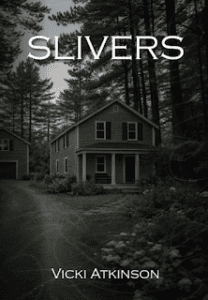
Vicki Atkinson is the author of the Eckhartz Press book Surviving Sue, and now she has written her first novel for us, Slivers. Vicki is a licensed professional counselor with a doctorate in Adult Education and degrees in Psychology. She is a consultant in private practice and lives near Chicago. We recently caught up with her to talk to her about her brand new novel.
EP: The story is set over the course of a single week in the summer of 1973. How does the specific political and cultural backdrop of the early 1970s complement the claustrophobic and tense atmosphere of the neighborhood?
Vicki: The early 70’s were both idyllic and tumultuous, especially if you were a kid trying to make sense of the world. As an eleven-year old girl in the summer of 1973, I felt the electricity — tension as I watched adults wrestle with cultural conundrums and palpable distrust for government after Vietnam, the shock about Nixon and Watergate.
I remember flying away on my Schwinn, cavorting with friends with complete freedom from dawn to dusk, unfettered by technology and fueled by Hostess Ho-Ho’s. But in the background? Suburban families were weary, parents disgruntled by long lines for gas and scandals on TV and yet…they were often euphoric about music.
The soundtrack for the summer of ‘73 had something for everyone — wholesome Tony Orlando and Dawn’s “Tie a Yellow Ribbon Round the Ole Oak Tree”, The Carpenters’ wistful “Yesterday Once More” and Cisco Kid’s “War” offered an edgy downbeat. Helen Reddy fueled feminism with her anthem, “I Am Women.” Marvin Gaye’s “Let’s Get it On”, was favored by partying parents who fit the description of suburban swingers. Everyone seemed poised to escape…something.
Situating a story about family secrets into this era felt right from the moment I began writing about a goofy family intent on denying their ancestral, paranormal skills.
EP: The teenagers in the book constantly sense that something is deeply wrong, even when their mothers assure them everything is fine. How does this affect the characters’ ability to trust their own instincts?
Vicki: The characters in “Slivers” have quirks. It was important for me to show their insecurities and anxieties by revealing their peculiar, mechanized, and ritualized compulsions, deployed when dubiousness about their mothers’ behaviors escalated.
When we’re told to ignore what we see, feel, believe – in order to accept “truths” that seem implausible, our self-confidence and trust is whittled away. When three of the main characters begin to compare notes and realize they’re not alone, the camaraderie they find boosts their resolve to dig deeper, to understand their mothers’ motivations to manipulate.
EP: Discuss the theme of female intuition and the generational “gift” in the main character’s family. How did this ability empower or burden the women in the story?
Vicki: In “Slivers,” the female characters wrestle with their intuitive abilities, creating a firestorm of conflict. The main character, Jane, is disconcerted by her knack for hearing the unspoken thoughts of others and feels like an outcast. Coming to terms with the skill and seeing it as a tool to wield — at will — is part of Jane’s journey to self-understanding, embracing her intuitiveness as both a burden and a blessing.
I tried to highlight the female super skill of intuitiveness throughout the story. Bolstered by neuroscience and what we know about intuition as a full body experience, the characters in “Slivers” respond to their environment with unease, sending signals that the brain may not understand — reminders to be watchful, hypervigilant.
Women have an edge in this regard because our brains are optimized for intuitive decision-making thanks to anatomy; women have a thicker corpus callosum than men, a bigger “bridge” between the left and right hemispheres of the brain. Reel in the facts but trust your gut, too.
EP: The novel depicts family dysfunction amplified by generations of mystical deceit. How did the secrets in the story act as both a form of protection and a source of harm to the younger characters?
Vicki: There’s a quote from Psychologist Carl Jung that sticks with me, years after I first read it, about secret-keeping and its destructiveness: “Anything concealed is a secret. The possession of secrets acts like a psychic poison that alienates their possessor from the community.” (The Red Book, Liber Novus, C.G. Jung 1914-1930)
Psychic poison.
I wanted to play that up, across generations. Write about toxic skeletons in the closet, secrets buried by a few with an intent to protect, but thoughtlessly so.
In “Slivers” managing the truth results in erratic behavior as the secret keepers, the mothers, become unhinged and unravel, right before their children’s eyes.
This volatility and toxicity wasn’t intended, of course. The mothers miscalculated and created a surge of supernatural chaos because of their duplicity. Good intentions run amok.
EP: You are a licensed counselor with a background in psychology. How does your professional background shine through in how the characters process their trauma and confront their tangled pasts?
Vicki: I’m a believer in building resilience through storytelling and empowerment. In my professional practice, I know we are all so much more than the circumstances and situations we’ve withstood in life, especially experiences within our “families of origin,” the families we’re born into.
In “Slivers” I wanted to show the complexity of relationship dynamics, the push-pull between truth-telling and safety-seeking. Characters display their quirks and self-soothing rituals and it was important for me to show (and “normalize”) the compulsions which provide comfort. It’s okay to be different, it’s okay to be you, to be unique.
A common denominator for most of us is family dysfunction of some sort. It’s not always dramatic or violent. Dysfunction can be insidious, lurking beneath the surface of daily living, detectable only when we examine patterns and distortions which manipulate or malign; destructiveness over time.
The main characters in “Slivers” become aware – curious, relentless, and empowered. They learn to trust their own instincts, overcoming the blockades and distortions created by their mothers.
EP: Describe the connection between this book and your previous book “Surviving Sue”
The inspiration for “Slivers” began with reader feedback about my mom, Sue’s highly intuitive behaviors and her unspoken conversations with her siblings in “Surviving Sue.”
Initially, I was reluctant to reveal any woo-woo anecdotes because they sounded nutty – disclosing that Sue could have full conversations with her sisters, exchanging thoughts, rapid-fire, without speaking. More disconcerting? Admitting – in print, publicly, for the first time, that I could sometimes tune in.
Readers were generous with their feedback, offering their own inexplicable examples of hyper intuitiveness. “Knowingness.” Examples of trusting one’s instincts, reading people, relying on our guts, our awareness of words withheld but detectable, just the same. Shifts in body language, “tells” in facial expressions which can be ultra revealing.
I loved those conversations with readers and they provided a powerful a-ha as I continued to grow in my understanding about the intense discord between my mom, Sue, and myself. Sue saw me as a threat, fearful that I might poke holes in her carefully orchestrated life of lies. Vicki was a problem.
My lived experience of surviving Sue helped me become empathetic and intuitive. But there was more. Another wave.
Readers’ input inspired me dig into the family archives, following vague references from a kooky Aunt Susan who characterized my mom’s Scottish family as a ‘band of misfits.’ I followed the trail to see what I could learn and the discoveries didn’t disappoint. “Surviving Sue” spawned an ancestral ghost story — “Slivers.”
Slivers is available now at Eckhartz Press.
It’s nice to read this great interview of Victoria!!
Thank you, Tim!
What a wonderful interview with Vicki !
Thank you, Maggie!
Great interview! I read both Surviving Sue and Slivers, and they are excellent.
Edward! Thank you for your kind words!