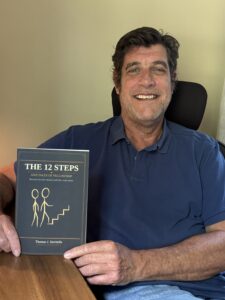
Tom Serritella is out with a brand new Eckhartz Press book. It’s called 12 Steps and Tales of Fellowship, and it’s about the road to sobriety. We caught up with Tom this week to talk to him about the book….
EP: You explicitly frame recovery as a “transformation” rather than a final destination. Why is that?
Tom: There is no “graduation” from the 12 Steps. As the book states, the last three steps are for the rest of my life. The steps teach a different perspective on life, allowing me to live in a new way. Almost immediately, I received wonderful gifts from my sobriety, and these gifts continue to come as long as I work the steps for the rest of my life.
EP: The 12 Steps are frequently perceived from the outside as rigid. How do you balance structure with the unpredictable, deeply human realities of addiction?
Tom: The 12 Step program is deceptively simple. It is similar to golf: hit a little white ball with a stick into a hole. That sounds incredibly simple, but anyone who plays will tell you a different story. The steps are very similar—work them to the best of your ability and you become sober. However, because of the difficulties that can arise, we have built-in assistance throughout the program. Sponsors and the fellowship found in meetings are a tremendous help. While the founding members of AA had only one meeting a week, today there are meetings throughout each day of the week. There is no reason for anyone struggling to say they couldn’t find help. We are almost always willing to help anyone in need.
EP: Woven throughout the text are deeply personal “Tales of Fellowship”. Which of these individual stories resonated with you the most?
Tom: I would have to say the story where I inadvertently became a sponsor. Becoming a sponsor changed my program. Ask any teacher and they will tell you, learning material as a student is one thing but learning material as a teacher is a whole different ballgame. Having to have the answers to a young man’s questions about how to work the program can be a daunting task. But the truth is, I took sponsorship very seriously. I wanted to be there for the guys I sponsor and truly want to see them succeed.
In order to be that kind of sponsor, I needed to go back on my program and make sure there weren’t any lingering questions I may have had or didn’t understand. I could then go to the big book or talk with my sponsor to get help. That is the basis of the program, the vulnerable helping the vulnerable. I would be remiss to not mention the story of sponsoring Santa Claus because it is really nice to find out what a great sense of humor God has. And of course, the final story focusing on my best friend, Tim and our first meeting together. Tim always used to tell me how our friendship was the most unique we have ever had because we were friends while we were drinking and friends who had recovered. I’m so proud of that relationship. It helped shape me in becoming the sober person I am today. “Just keep rowing.”
EP: Interpersonal connection and communal strength are major pillars of the book. What limits do individuals face when trying to “walk this road alone”?
Tom: Great question! If you try to envision the shape of someone just coming into Alcoholics Anonymous, you might see how help would be essential. For me, like I describe in my book, my first meeting I was a mess. I was dirty and shaking. I had no idea what to expect. Above all, I was scared. I simply had no idea what it would be like to live life without alcohol. Alcohol was my savior. No matter how bad life got, alcohol cured it for me. Sometimes needing more than other times. Not to mention, I hadn’t had a decent night’s sleep in months. I lost my career. My wife was leaving me and taking the kids. I had nowhere to go and zero goals. I had zero hope and had become desperate. Does this sound like a person who could interpret and work on the 12 steps of recovery on his own? I think not!
Sure I could get started but like many, frustration from the uncertainty of doing them right and the confusion over interpretation would most likely lead me to bailing on the project all together and go back to drinking. When I was first in the program, I was aware of the fact that if things didn’t go well, I was gonna get to go back to drinking. I always had that.
EP: Why is humor such a critical tool?
Tom: Our book says “We are not a dull lot.” The laughter I have shared with my friends in the AA fellowship is some of the best I have ever had. I remember belly laughing real strong one day and thought to myself, “Man, I haven’t laughed like that in a long time.”
It’s important for newcomers to see those of us with some sobriety time being happy. Why would anyone want to get sober if the people in sobriety were miserable. Our greatest attraction to those thinking of getting sober is the wonderful way we live our lives.
EP: You’ve been on this road now for 14 years. What reality (proand/or con) would the younger Tom be most surprised about this older and sober version of Tom?
Tom: I would think the greatest surprise I would have would be my advanced state of awareness of myself. The program teaches me to review my day at night. I like to look at my actions and decisions I have made throughout each day. Most of the time there are no issues but sometimes I run into stressful or frustrations during my day. It is in these times I try to be a better me.
I know my actions and decisions shape who I am but being aware of when these times creep up is critical. When I was drinking I had no idea the difference between when my behavior was good or when it was bad. In sobriety, my behavior is for the most part very good. I am a very happy and grateful person. There are times when frustration and angst can crop up in me. It is in those times I can use the program to help me work through them and be a better me by making solid decisions. If I’m unaware of these times of struggle, I have no idea how to work on myself. And conversely, if I am aware I can work on the issue and therefore be better the next time. Pretty soon, by correcting these issues in my life, I can continue to grow and become better and better.
12 Steps and Tales of Fellowship is available now at Eckhartz Press. Tom is having his Book Launch party on August 8th (1:30–3:30pm) at Moretti’s in Hoffman Estates (just off I-90). Come on out, say hello, and buy a few books. Tom will happily sign them.
Leave a Comment